The Man Behind the YMCA Triangle: Ethel Dorgan's 1934 Columbia Dissertation on Luther Halsey Gulick
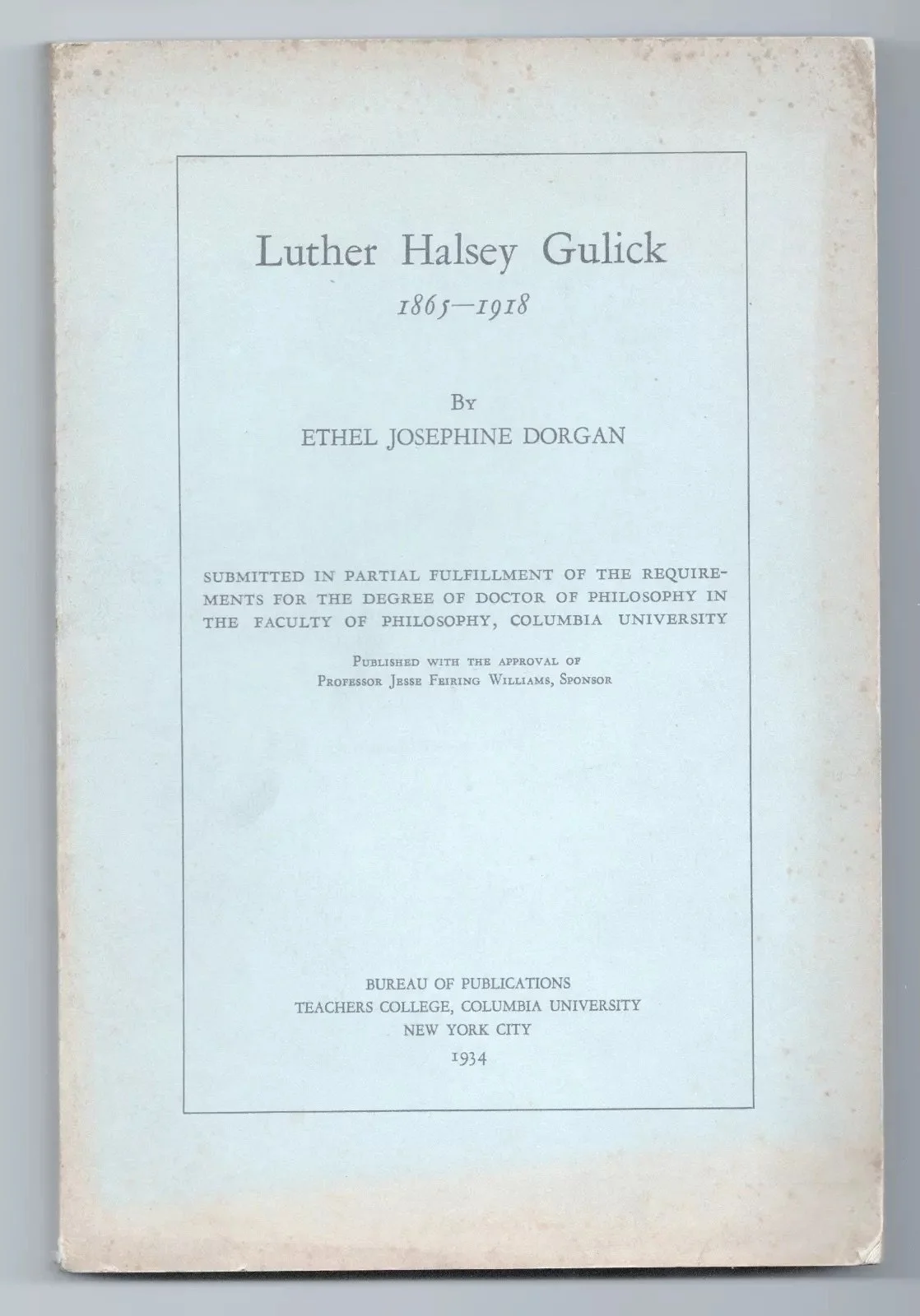
This is the original 1934 printing of Ethel Josephine Dorgan's doctoral dissertation, submitted to Columbia University's Faculty of Philosophy in partial fulfillment of the Ph.D. and published by the Bureau of Publications at Teachers College "with the approval of Professor Jesse Feiring Williams, Sponsor." It is an academic work, not a commercial publication, and it was written 16 years after Gulick's death in 1918, when the people who knew him and the movements he built were still within living memory. The Teachers College edition runs to 180 pages, and it has held up well: since no modern biography has been published, one historian noted, Dorgan's 1934 work remains a solid, informative source. Copies from the original printing, as opposed to the reprints that came later, are a direct link to the first scholarly attempt to take the measure of his life.
Gulick was a foundational figure in American physical education, youth development, and organized recreation. Born in Honolulu in 1865 to a missionary family, he led the physical education department at the International YMCA Training School in Springfield, Massachusetts, now Springfield College, from 1887 to 1900. He devised the YMCA's emblem, and he's part of basketball's origin story: he challenged a Springfield class to imagine a new indoor game, and James Naismith invented basketball in response. His work extended far beyond Springfield. He directed physical education for the New York City schools and helped create the Public School Athletic League in 1903, founded the Russell Sage Foundation's child hygiene department in 1907, and in 1910 helped found the Camp Fire Girls, which he co-founded with his wife, Charlotte. He also helped lead the Playground Association of America. He died in 1918 at 52, and this dissertation is the earliest serious biography of the man.