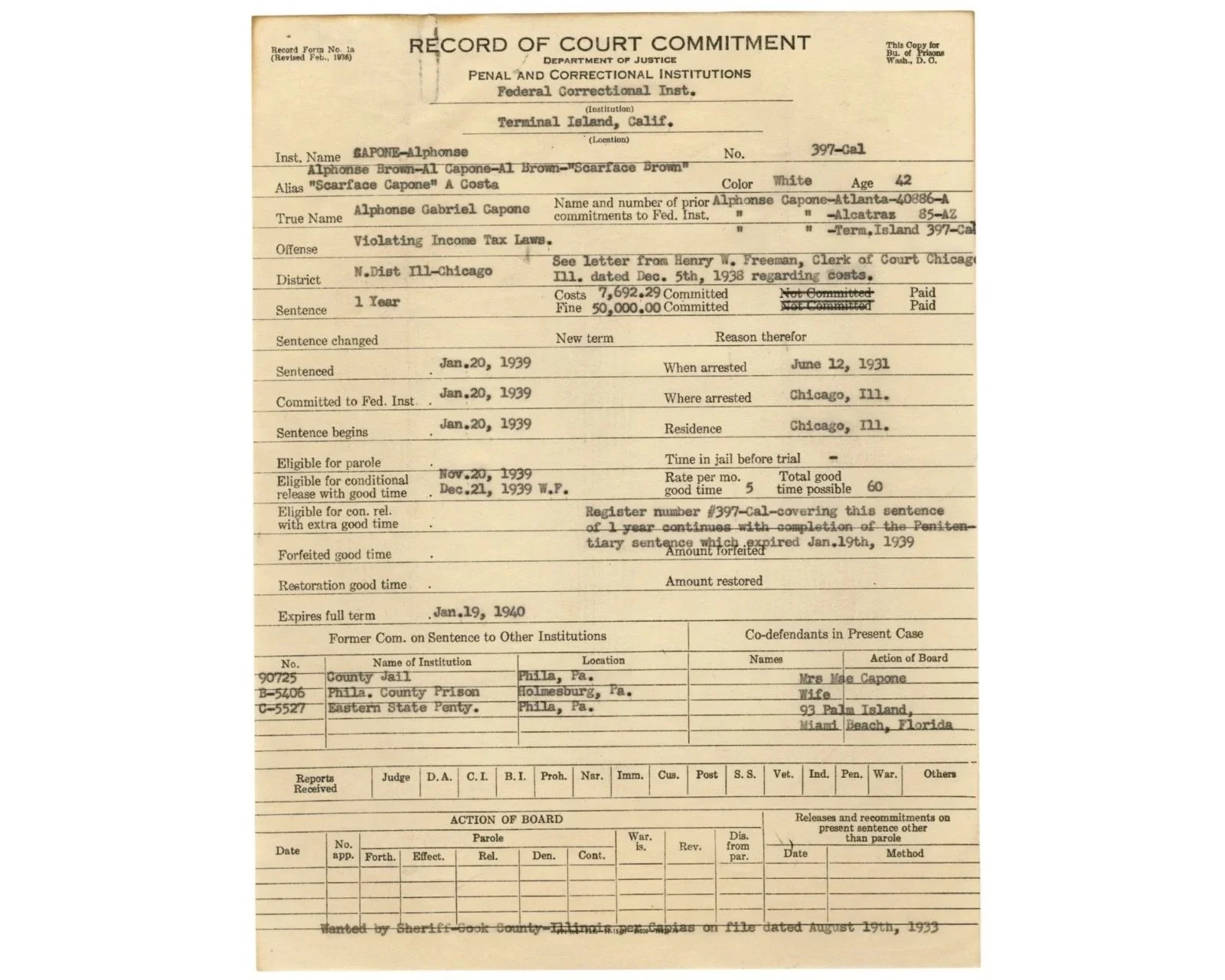
Al Capone's Department of Justice Transfer Document from Alcatraz to Terminal Island, January 1939
By the time Al Capone was transferred from Alcatraz to the federal penitentiary on Terminal Island, California in January 1939, his name had already become shorthand for the entire era of Prohibition-era organized crime. The government finally got him not for bootlegging or violence, but for tax evasion, and the 11-year sentence that followed sent him first to Atlanta, then to Alcatraz, the island fortress built in part with men like him in mind. This document is his official intake record at Terminal Island, created the moment he stepped off that transfer and into the custody of a new institution, closing out the Alcatraz chapter of his imprisonment and opening the final one. It lists his legal name, Alphonse Gabriel Capone, alongside his aliases, his conviction, his sentence, and the paper trail of prior commitments that traced his path through the federal system.
What makes this document worth holding onto is the moment it captures. Terminal Island wasn't where Capone served his original sentence, it's where he finished a separate one-year term tacked on for unpaid court costs, and it's where his health, already failing from untreated syphilis, led to his early parole and release that November. The form itself is a staff-prepared administrative record rather than something Capone signed or handled personally, which is worth being upfront about, it's paperwork generated about him, not by him. But it ties directly to the closing months of one of the most consequential criminal prosecutions in American history, and it names his wife, Mae Capone, as co-defendant at their Palm Island home in Miami, a detail that connects the document to the man's life outside the walls as much as his time inside them.